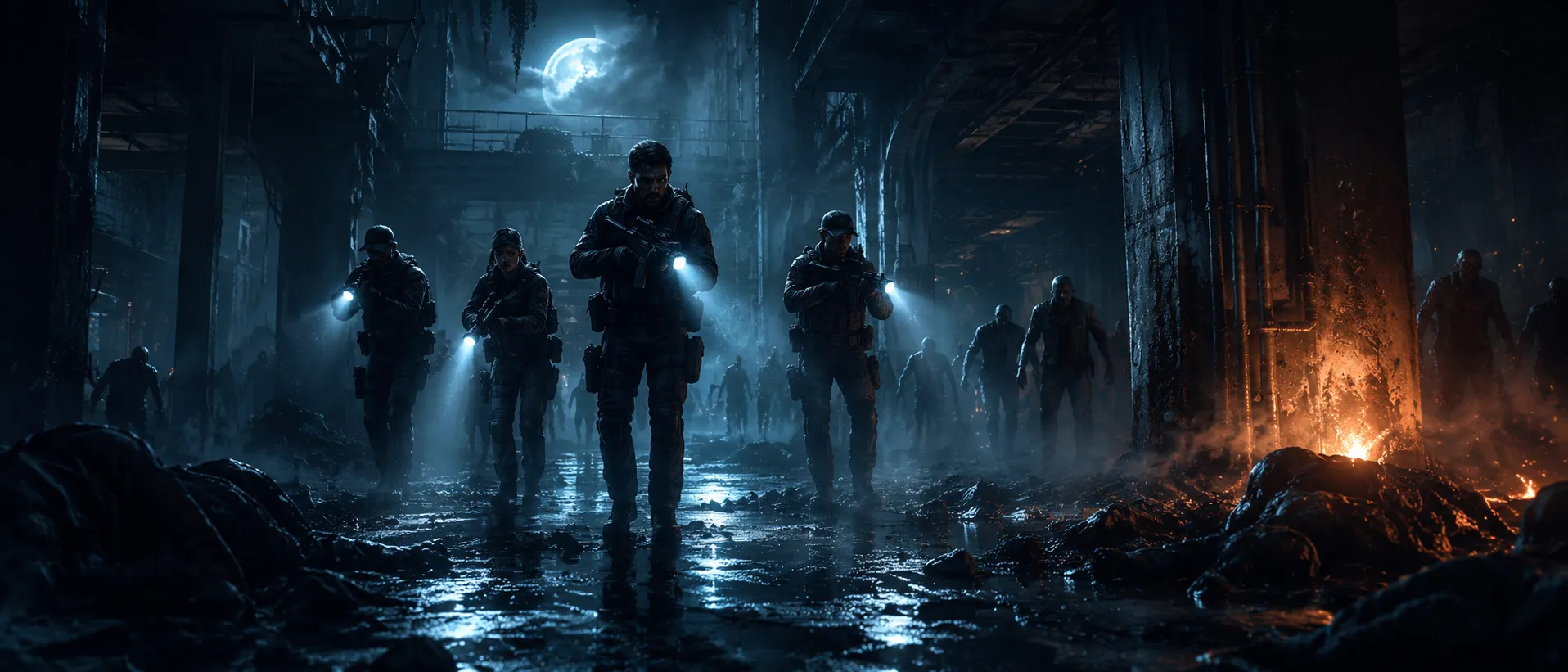
Co-op Survive throws players into a brutal co-op nightmare where every quiet moment feels temporary and every mistake can snowball into a team wipe. At first glance it looks like a familiar zombie shooter, but the deeper appeal comes from how it mixes scavenging, wave defense, tense movement through hostile spaces, and a boss-focused endgame into one continuous pressure cooker. You are not just mowing down undead for points; you are searching for weapons, stretching limited supplies, covering teammates in dark corridors, and preparing for one final showdown that demands real coordination.
Why Co-op Survive feels different from standard multiplayer zombie games
What makes Co-op Survive stand out is that it does not treat cooperation like a bonus feature. It is built around the idea that the best way to survive with friends is to make every player matter, whether they are carrying ammo, holding a choke point, drawing enemies away from a revive, or making the call to retreat before a wave collapses on the team. That creates a different rhythm from standard zombie games where one overpowered player can often drag everyone else through the match.
Co-op Survive also leans hard into uncertainty. Weapons are valuable because they are earned through exploration and risk, not simply handed out in a predictable progression path. That means every run can develop its own story. One squad might get lucky with an early firearm and stabilize fast, while another spends the opening stretch improvising with weaker tools and barely scraping through until their loadout improves. The result is a game that feels less like an arcade loop and more like a horror scenario that keeps adapting around your decisions.
Most importantly, the game never lets you forget the stakes. The atmosphere, the pressure of incoming waves, and the looming presence of the Patriarch all combine to make Co-op Survive feel like a mission rather than a match. You are not just chasing kills; you are trying to make it to the end intact.
The cooperative gameplay loop that drives every run in Co-op Survive
The core loop in Co-op Survive is simple on paper and intense in practice: explore, gather, defend, recover, and prepare for the next escalation. Teams move through dangerous areas to secure useful gear, then brace for zombie waves that punish bad positioning and wasted ammunition. After each burst of chaos, there is a brief but meaningful reset where players heal, redistribute supplies, and decide what the squad needs most before heading back into the dark.
That loop works because it always asks the team to balance short-term survival against long-term planning. Do you burn through your best ammo now to avoid taking damage, or save it for the next wave when specials might appear? Do you split up to search faster, or stay close and accept slower progress in exchange for safety? Co-op Survive makes those questions feel urgent, which is why each session starts to resemble training for zombie apocalypse more than a casual round of target practice.
The smartest teams learn that momentum matters. A squad that communicates early, calls out enemy directions, and keeps moving as a unit will usually enter later rounds in stronger shape than one that treats the game like a free-for-all. In Co-op Survive, discipline is part of the fun.
Finding gear and crafting the weapons your squad needs
Looting in Co-op Survive feels satisfying because useful gear changes what your team can attempt. A decent weapon is not just extra damage; it is confidence, breathing room, and permission to push into riskier spaces. Early scavenging runs often define a match, especially when one player finds a firearm that can anchor the group while others keep searching for ammunition, healing items, or crafting materials.
Crafting adds another layer by turning scavenged components into practical upgrades instead of random junk. That creates a strong sense that your squad can build to survive, adapting to the threats that are actually appearing rather than hoping the game drops exactly what you need. Maybe you reinforce a close-range setup for holding doors, or maybe you prioritize something with better stopping power for elites and bosses. Either way, the crafting system rewards teams that talk through their roles instead of greedily hoarding everything they find.
Share high-value ammo with the most accurate shooter.
Give durable close-range weapons to the player holding the front line.
Save versatile materials for tools or upgrades the whole team benefits from.
Think about the Patriarch fight while crafting, not just the next wave.
Because resources are limited, the gear game in Co-op Survive always carries tension. A squad with good communication can turn average finds into a balanced loadout, while a disorganized team can waste excellent equipment through bad allocation.
Surviving the horror atmosphere and relentless waves of zombies
Co-op Survive understands that zombies are more frightening when the world around them feels hostile too. Lighting, sound design, and claustrophobic spaces make even basic encounters feel uneasy, especially when the team knows a larger wave is building. The game does not rely only on jump scares; it builds dread through distance, silence, and the sense that something is always moving just beyond your line of sight.
When the waves finally hit, that dread turns into raw pressure. Zombies flood chokepoints, surround stragglers, and force constant target prioritization. Players who panic and fire wildly usually run dry at the worst possible moment. The better approach is controlled aggression: keep lanes covered, stagger enemies before they stack up, and call out flanks immediately. Co-op Survive shines in those moments where four players are barely holding together, the room is closing in, and one reload away from disaster.
The horror atmosphere matters because it changes how combat feels. Shooting zombies is not just mechanically satisfying; it is emotionally charged. Every successful stand feels earned, and every narrow escape deepens the sense that the next wave could be the one that finally breaks the squad.
Hunting, scavenging, and supply runs between the chaos
Between major fights, Co-op Survive opens up into a more deliberate survival experience. These stretches are where teams hunt for resources, sweep side areas, and make risky supply runs that can transform the next phase of the match. The pace slows just enough to let players breathe, but never enough to feel safe. Every extra second spent searching raises the chance that the next encounter catches the squad out of position.
This is where good teams separate themselves from reckless ones. A smart supply run has a plan: one player leads, one watches the rear, one tracks loot priorities, and one stays ready to revive or cover a retreat. Even hunting for basic necessities becomes engaging because every item serves a real purpose. Ammunition means another wave can be held. Medical supplies mean the group can recover from mistakes. Crafting components mean the team can refine its approach instead of repeating the same strategy and hoping for better luck.
There is also a strong survival fantasy in these moments. Co-op Survive captures the feeling of being stuck in hostile territory, scavenging whatever you can, and trying to return before the dead close in again. Those supply runs make the firefights hit harder because you understand exactly what each bullet and bandage cost.
How to prepare for and defeat the Patriarch in Co-op Survive
The Patriarch is the final boss of Co-op Survive, and the game wisely treats that encounter like the ultimate exam for everything your squad has learned. Teams that stumble into the fight underprepared usually discover very quickly that normal wave-clearing habits are not enough. The Patriarch demands concentrated damage, disciplined movement, and clean communication under pressure.
Preparation starts long before the boss arena. Your team should enter the fight with a clear loadout plan, enough healing to survive mistakes, and at least one player ready to manage add pressure if lesser zombies appear during the encounter. Ammunition economy matters too. If your squad empties its strongest weapons during the final approach, the Patriarch becomes a punishing battle of attrition instead of a winnable climax.
Once the fight begins, spacing is critical. Stay close enough to support each other, but not so close that one attack disrupts the whole team. Focus fire when safe, revive only with cover, and never lose track of the boss during repositioning. Co-op Survive turns the Patriarch battle into a real co-op payoff: the squads that planned carefully and preserved resources finally get to prove they can survive with friends when it matters most.
Best team strategies for friends jumping into Co-op Survive together
For new groups, the best strategy in Co-op Survive is to avoid treating everyone as a copy of everyone else. Even informal roles help enormously. One player can specialize in front-line control, another in accurate ranged damage, another in resource awareness, and another in emergency support. You do not need rigid classes for this to work; you just need a shared understanding of who is doing what once the wave starts crashing in.
Communication should stay simple and useful. Call out enemy direction, low ammo, healing needs, and retreat routes before things become desperate. Friends who chatter constantly but never share relevant information often perform worse than quieter teams with better habits. If your group wants to survive with friends consistently, learn to prioritize timing, spacing, and loot sharing over chasing individual hero moments.
The other big tip is to treat every failed run as valuable experience. Co-op Survive is at its best when friends improve together, noticing which routes are safer, which weapons fit each player, and when to push versus when to reset. That constant learning loop gives the game its staying power. Whether you are entering for the horror, the zombie gunplay, or the thrill of downing the Patriarch at the end of a brutal session, Co-op Survive rewards teams that act like a squad from the first scavenging run to the final shot.