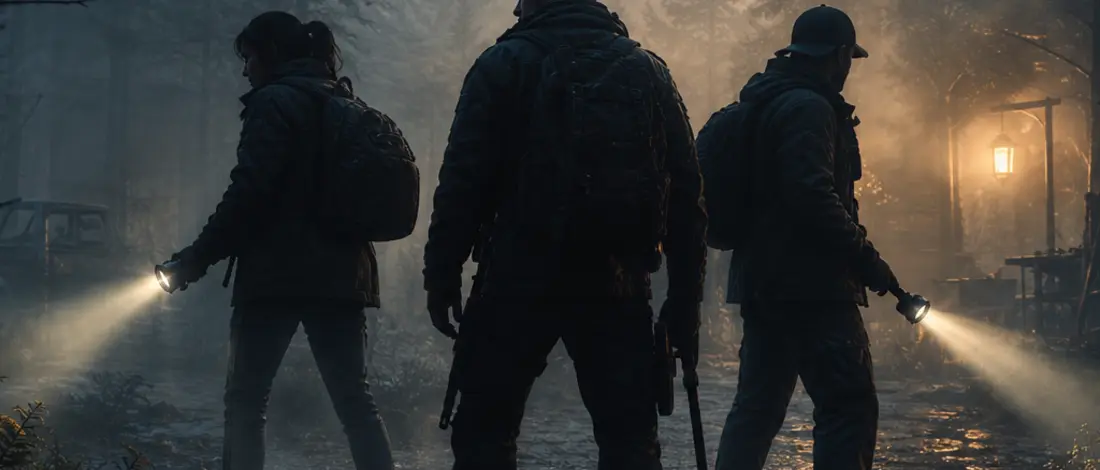
In co op survival games, the scariest shortage is often not food, ammo, or shelter. It is trust: the invisible resource that decides who shares, who risks a rescue, and who keeps the team together when everything starts going wrong.
Why Trust Is the Real Survival Resource in Co-Op Survival Games
In co op survival games, trust works like a hidden survival stat. A squad with average gear but reliable habits often outperforms a better-equipped group that second-guesses every call. When resources are scarce, every revive, trade, and detour becomes a social choice as much as a tactical one. Do you spend your last medkit on the injured scout? Do you hand over rare ammo because your teammate is the better shot? Those decisions are rarely solved by mechanics alone. They depend on whether players believe the group is acting for shared survival rather than private advantage.
That belief has a direct effect on performance. Reliable teammates reduce mental load, which matters when pressure is high. If you trust that someone is watching the rear, tracking supplies, or calling out threats, your brain can focus on execution instead of suspicion. In terms of player psychology, trust lowers stress, sharpens decisions, and helps groups recover faster from mistakes. The result is stronger immersion, smoother runs, and a better chance that the same team wants to queue up again tomorrow.
- Trust makes risky revives and clutch saves feel rational instead of reckless.
- It turns resource sharing into strategy rather than an argument.
- It reduces panic because players expect support, not abandonment.
- It improves long-term chemistry, which is often the real endgame in teamwork-heavy runs.
How Trust Forms Between Players in Survival Games
Trust in survival games usually grows from three things: consistency, competence, and repeated cooperation. A teammate who always calls out danger, shows up for revives, and sticks to agreed plans becomes predictable in the best way. Competence matters too, but not only as raw skill. Players trust others who are dependable under pressure, who know when to push and when to disengage, and who do not create chaos for ego. Over time, small successful moments stack up into real multiplayer trust.
Early trust often lives or dies through communication. Good voice chat, smart pings, and clear callouts build confidence fast, especially among strangers. This is why team communication in games matters so much: players judge reliability through tone, timing, and clarity before they fully judge aim or game knowledge. A simple “two hostiles east, low ammo, fall back to base” does more for group confidence than a flashy solo play. Clear information tells the team that someone is thinking collectively.
Shared goals also accelerate trust. When one player scouts, another crafts, and another manages defense, role specialization creates healthy dependence. Friends often begin with social trust and then prove it in action, while strangers usually earn trust from the ground up through behavior. Both paths work, but in teamwork in survival games, nobody keeps trust for free. Even friends lose it if they become careless, greedy, or dismissive of the group plan.
When Trust Breaks: Betrayal, Greed, and Misread Intentions
Trust breaks quickly because players remember social pain more vividly than efficient teamwork. Common trust killers are familiar to anyone who plays survival games: loot hoarding, running from fights without warning, hiding key information, or taking group resources for personal upgrades. Some titles even lean into betrayal mechanics, making selfish play part of the tension. That can be exciting, but it also teaches players to question motives in moments where cooperation should be automatic.
Still, not every bad outcome is true betrayal. Sometimes a teammate panics, misreads the situation, or simply lacks experience. A missed revive may come from confusion rather than malice. A poor rotation might be a knowledge gap, not a deliberate ditch. Strong groups learn to separate harmful intent from honest mistakes, because if every failure is treated as treason, the team becomes paranoid. Once that happens, people start saving loot for themselves, withholding information, and making defensive choices that weaken the whole squad.
- True betrayal usually involves selfish intent or repeated deception.
- Honest mistakes tend to come with confusion, apology, or visible panic.
- Unclear communication often turns neutral moments into blame-heavy arguments.
- One ugly incident can erase several good runs if the group never addresses it.
The emotional fallout is just as important as the mechanical one. Frustration becomes blame, blame becomes tilt, and tilt destroys group momentum. In player psychology terms, a broken trust loop narrows attention and makes people interpret future actions more negatively. The next silence sounds suspicious. The next missed shot feels personal. Teams do not just lose items when trust collapses; they lose their sense of shared purpose.
The Game Design Mechanics That Build or Test Trust
Good game design does not treat trust as a speech about friendship. It builds trust through systems. Shared objectives, revives, and base-building all reward cooperative gameplay by making players invest in each other. If the healer saves the builder, and the builder keeps the shelter running, the game creates natural interdependence. That is one reason the best survival games feel social even when nobody says much: the systems keep nudging players toward mutual reliance.
At the same time, strong design also tests that reliance. Scarcity, permadeath, and friendly fire raise the stakes of every decision. When bullets are limited and death is costly, players reveal what they value most. Asymmetric information does the same thing. Maybe one player heard a threat in the dark, another found a partial map, and a third saw movement but cannot confirm what it was. In those moments, trust means acting on incomplete knowledge because you believe your teammates are trying to help, not mislead.
The most effective systems make dependence rewarding without becoming relentlessly punishing. If failure feels arbitrary, players stop learning trust and start gaming risk. But when the rules are readable, survival games can create a satisfying loop: coordinate, survive, gain confidence, and coordinate even better next time. That is where mechanics and human behavior meet.
Why Trust Feels Even More Intense in Co-Op Horror Games
Trust becomes even more powerful in co op horror games because fear amplifies dependence. Darkness, strange audio cues, limited visibility, and sudden threats all make solo certainty impossible. Players lean harder on the group because the environment itself is designed to erode confidence. In slower survival games, a bad decision may cost supplies. In co op horror games, one missed callout can trigger panic for everyone at once.
That is why communication becomes almost physical in horror. A calm voice can stabilize a team the way a health item stabilizes a character. Simple updates like “door on the left,” “I heard footsteps upstairs,” or “stay together” cut through fear and restore control. Panic also exposes weak habits quickly. Teams that interrupt, overtalk, or hide mistakes tend to unravel fast, while teams with clean communication rhythms often feel braver than they actually are.
Genre examples make the pattern obvious even without naming a specific game. Ghost hunts, monster chases, and low-light extraction runs all turn trust into an emotional survival tool. You are not just asking whether a teammate can shoot straight. You are asking whether they will stay calm, tell the truth, and come back for you when the sound design says they absolutely should not.
How Players Can Build Stronger, Healthier Teams in Co-Op Survival Games
The simplest way to build better teams in co op survival games is to set expectations before pressure hits. Decide how loot will be shared, who leads rotations, how aggressive the pacing should be, and when revives take priority over damage. These small agreements prevent many future arguments because players no longer have to guess what the team considers fair. Good teamwork in survival games starts long before the first emergency.
Communication habits matter just as much. Keep callouts concise, give quick status updates, and admit mistakes early. “I used the last bandage,” “I lost sight of the target,” or “I overpushed, that is on me” can save a run and a friendship at the same time. This kind of team communication in games creates a culture where information flows faster than blame. People feel safer speaking up, which means the squad makes better decisions more often.
- Set loot and revive priorities at the start of the session.
- Use short, consistent callouts instead of long explanations mid-fight.
- Own errors quickly so the team can adapt without drama.
- Do a short post-match debrief if tension showed up during the run.
That last habit matters more than many players think. A two-minute debrief can clear misunderstandings before they harden into grudges. Ask what worked, what felt unfair, and what to change next time. The goal is not to turn games into meetings. It is to protect the trust that makes cooperative gameplay satisfying in the first place. When teams practice honesty, clarity, and a little patience, co op survival games become more fun, more fair, and much more durable for everyone involved.